

Bus and driver scheduling, explained.
How a timetable becomes vehicle blocks and drivers' duties, and what makes a schedule efficient.
From timetable to buses and drivers
A registered timetable says when buses leave each stop. It doesn't say which bus does which journey, or which driver drives it. Bus scheduling turns the timetable into two plans: vehicle blocks for the buses, and duties for the drivers.
Good scheduling means running the same timetable with fewer buses and fewer paid hours, while staying within the rules and giving drivers sensible days.
The words schedulers use
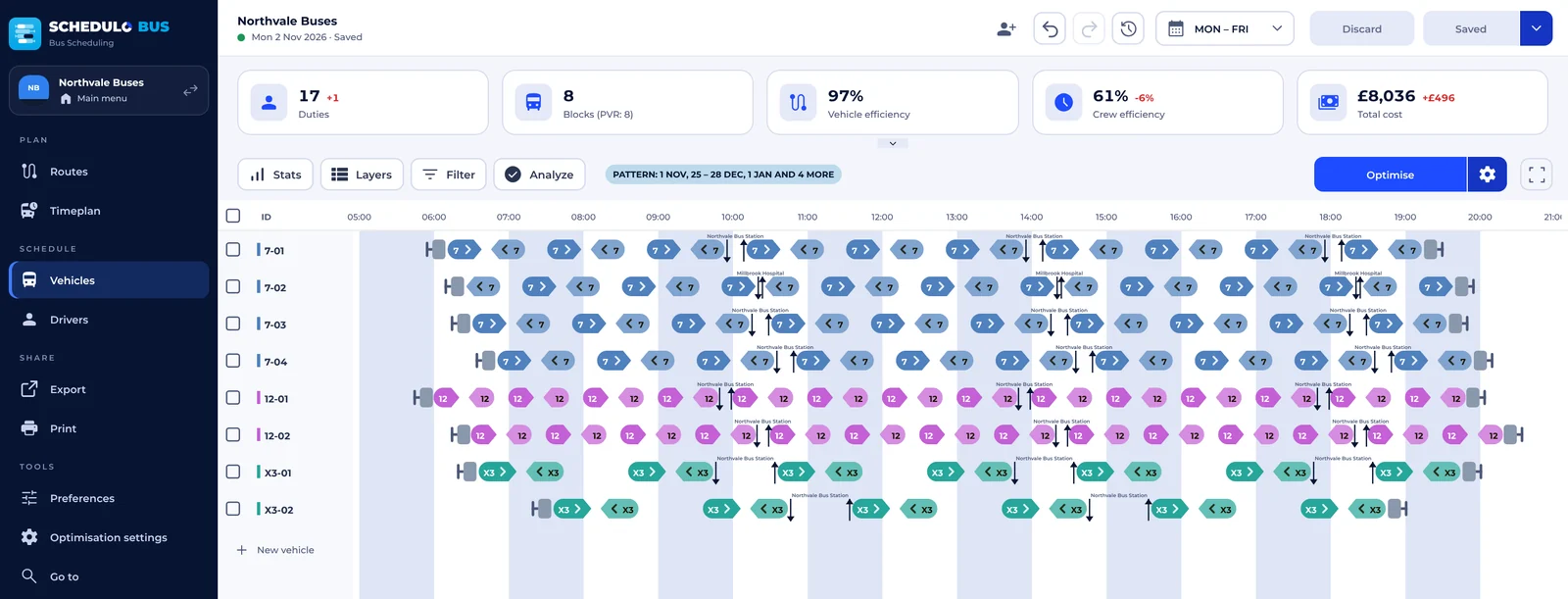
- Block (or vehicle working): everything one bus does in a day, from leaving the depot to returning.
- PVR (peak vehicle requirement): the most buses needed on the road at once, usually in the morning peak. It drives how big a fleet you need.
- Layover and recovery: time at the end of a trip before the next one, to absorb delays and give drivers a breather.
- Dead running: a bus moving without passengers, such as from the depot to the first stop.
- Interworking and interlining: one bus working journeys on more than one line, which often saves a vehicle.
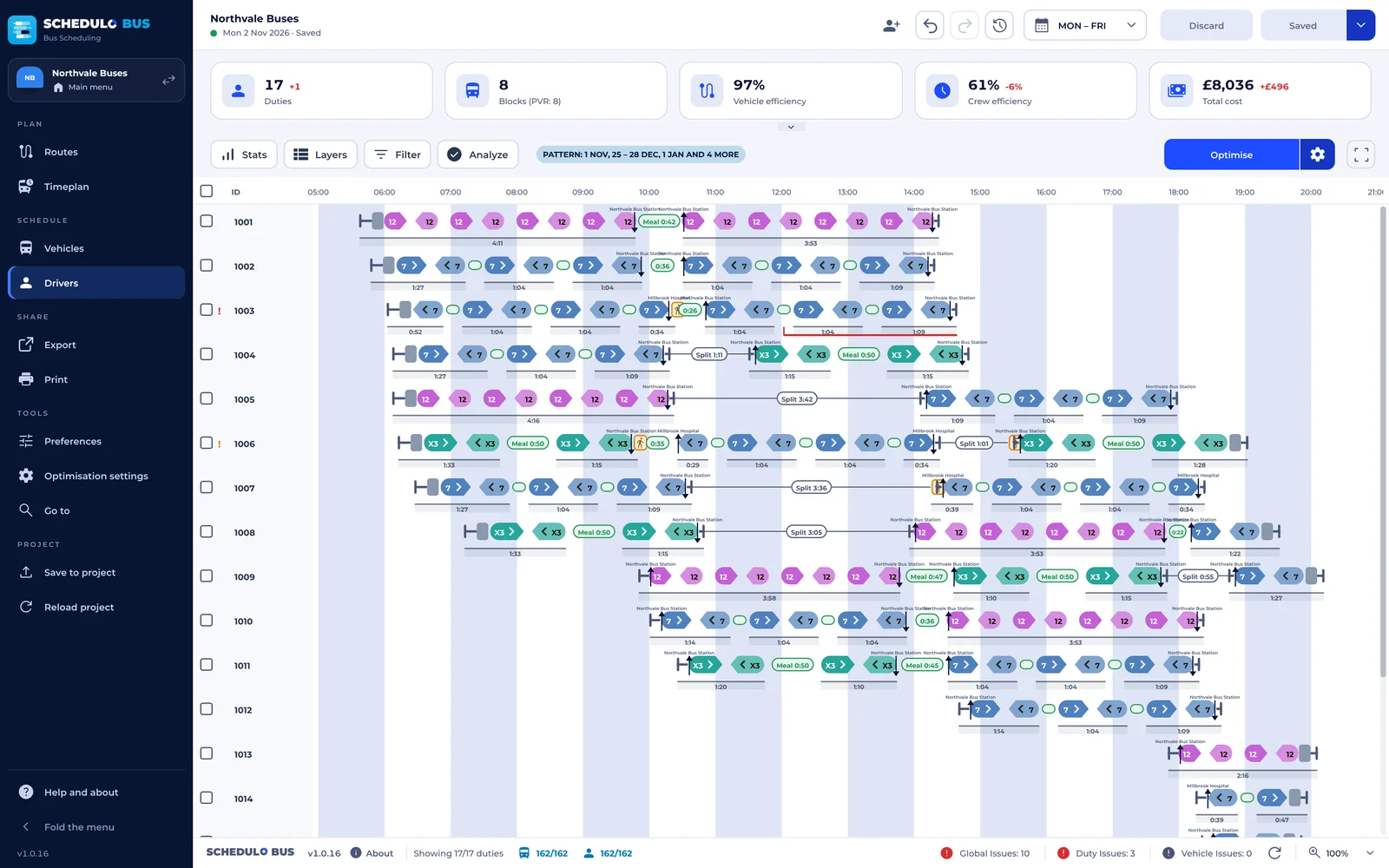
- Duty: one driver's day of work, made of pieces of blocks with breaks between them.
- Relief point: a place where one driver can hand a bus over to another.
- Spreadover: the time from the start to the end of a duty, including breaks.
- Running board: the sheet that tells the depot which bus does which trips.
Building vehicle blocks
Blocks are built by chaining journeys together: a bus finishes one trip and, after enough layover, starts the next one from the same place, or runs empty to somewhere nearby. The aim is to cover every journey with as few buses and as little dead running as possible. Linking lines that meet at the same terminus (interworking) is often where the biggest savings are.
Cutting blocks into driver duties
Duties are made by cutting blocks into pieces at relief points and combining them into a day's work for each driver. Each duty has to respect:
- Drivers' hours law. For example, under the GB domestic rules that usually cover local bus services, a driver can drive for up to 10 hours a day and must take a break after 5½ hours of driving. Routes over 50 km follow different rules. Always check the current DVSA guidance.
- Your own agreements: minimum and maximum duty length, meal breaks, maximum spreadover and paid time.
- Practicalities: where drivers can take a break, travel time between relief points, and signing on and off at the depot.
Measuring a good schedule
- Vehicle efficiency: how much of each bus's day is spent in service rather than waiting or running empty.
- Crew efficiency: how much of each paid duty is spent driving in service.
- Total cost: buses, paid hours, mileage and overtime together.
Tip: plan each day type (Monday to Friday, Saturday, Sunday, school holidays) separately. A schedule that works on a school day can waste buses in the holidays.
Doing it with Schedulo Bus
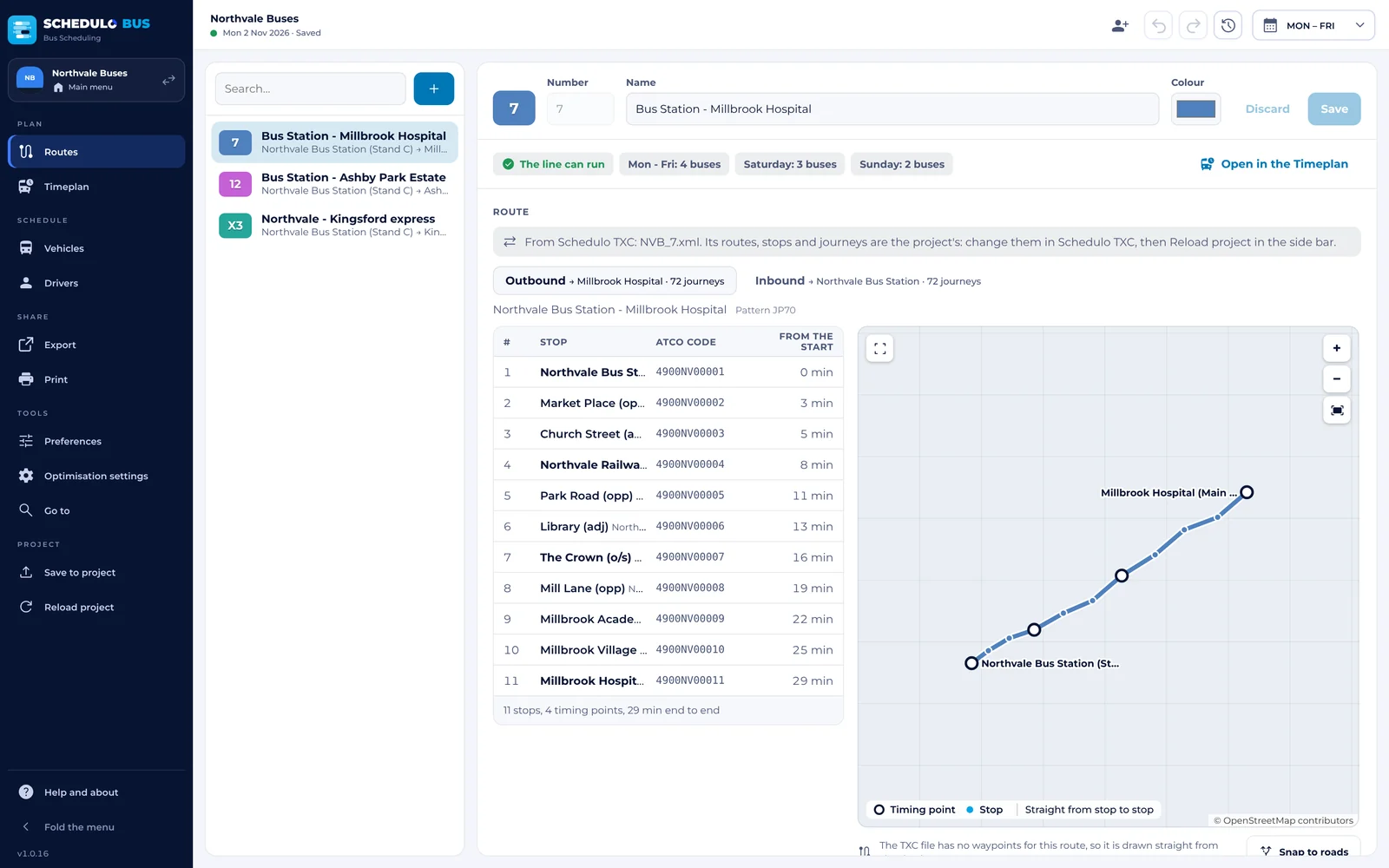
Schedulo Bus is bus and driver scheduling software for UK operators. It opens your TransXChange timetables, builds vehicle blocks with interworking and interlining, cuts them into duties under your working-time rules, and shows vehicle efficiency, crew efficiency and cost as you go. You stay in charge: drag trips between blocks, and nothing is saved until you press Save. Running boards, duty cards and reports print in your own colours, and with Schedulo TXC the block numbers and duties go back into the timetable you publish.
Ready to plan smarter?
Ask for a demonstration, a trial or a licence key, or tell us what your operation needs. Every message goes to the right person at Newey Transport Services, and we reply by e-mail.
- Demonstrations and general questions
- ContactUs@schedulo.uk
- Licence keys and renewals
- Licence@schedulo.uk
- Help with Schedulo TXC, Bus or licensing
- Support@schedulo.uk
- News and updates
- Follow Schedulo on LinkedIn